In an era dominated by rapid 5G deployment and the expansion of smart cities, telecom operators face unprecedented challenges in scaling and managing their fiber optic infrastructure. Traditionally, companies have managed these networks in fragments—using AutoCAD files for engineering design, disconnected Excel sheets for asset tracking, and legacy databases for operations.
This segmented approach creates critical operational silos. It leads to data mismatches, costly field delays, and inflated operational expenses. The definitive solution to this complexity is Unified Fiber Management. By bringing the entire passive network infrastructure under a single, cohesive geospatial framework, operators can unlock true operational excellence.
What is Unified Fiber Management?
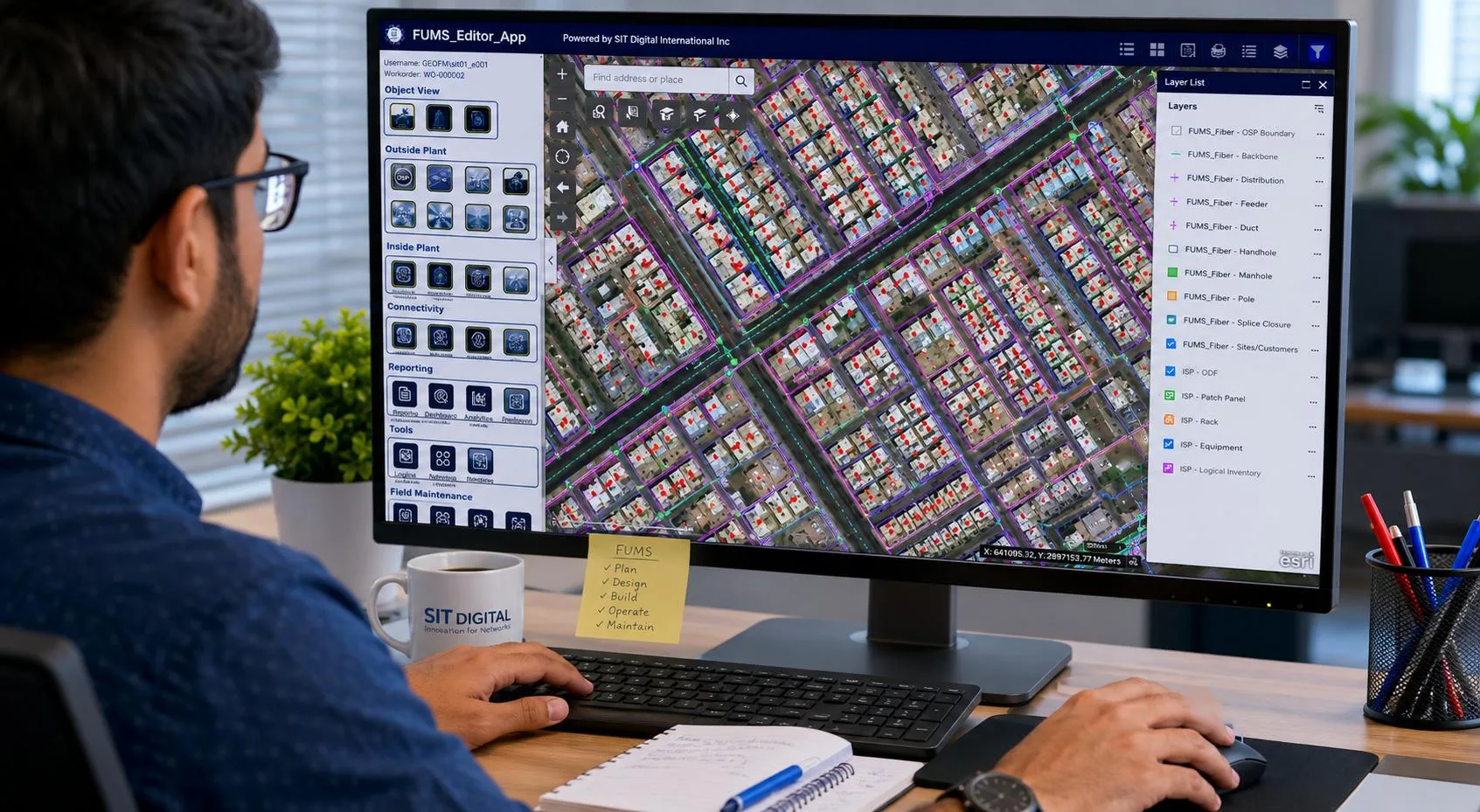
Unified Fiber Management is a holistic approach that consolidates all phases of the fiber network lifecycle—including planning, high-level and low-level design (HLD/LLD), construction, as-built updates, and maintenance—into a single pane of glass.
Instead of treating Outside Plant (OSP) assets (like underground ducts, cables, and splice boxes) and Inside Plant (ISP) assets (like passive racks, patch panels, and ODFs) as separate, isolated data layers, a unified system binds them together natively through spatial data. At SIT Digital, this transformation is powered by our flagship enterprise system, FUMS™ (Fiber Utility Management System / GeoFM™).
The Core Pillars of SIT Digital’s Approach
1. End-to-End OSP and ISP Integration
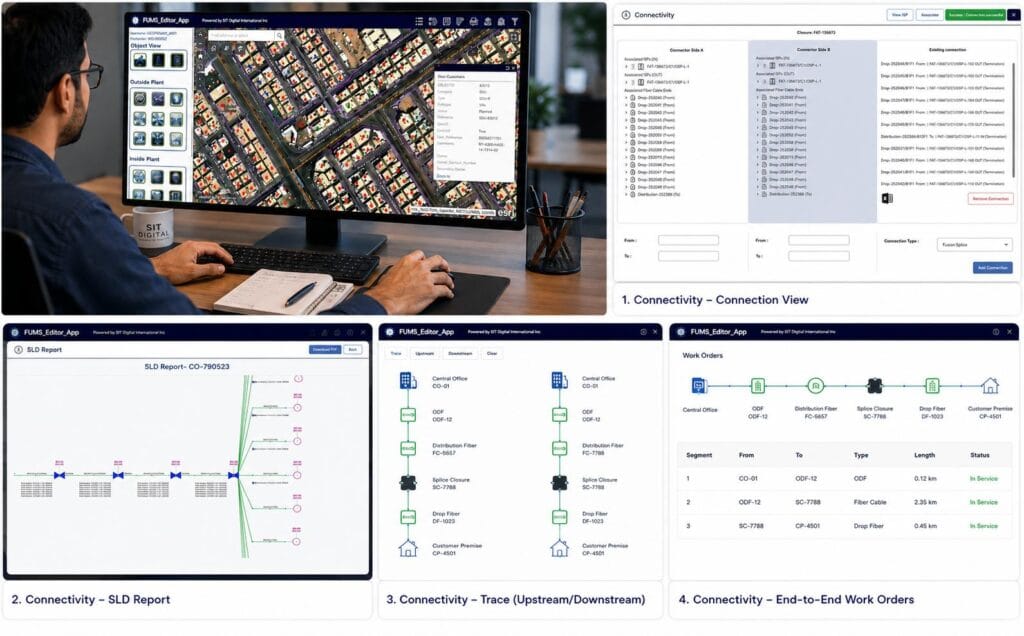
A robust network model cannot stop at the building’s entrance. To achieve true end-to-end circuit tracing, data must flow seamlessly from the central office (ISP) all the way down to the final drop-cable at the customer premise (OSP). SIT Digital’s system synchronizes both layers natively, allowing operators to execute instant logical and physical trace pathways during network events.
2. Built on Native Esri ArcGIS Ecosystem
Legacy, flat-file GIS utilities fail to scale with modern enterprise demands. Our unified framework is engineered natively on the advanced Esri ArcGIS Enterprise engine. This equips telecom operators with real-time base maps, sophisticated spatial analytics, and highly interactive, multi-layered geospatial views instead of static drawings.
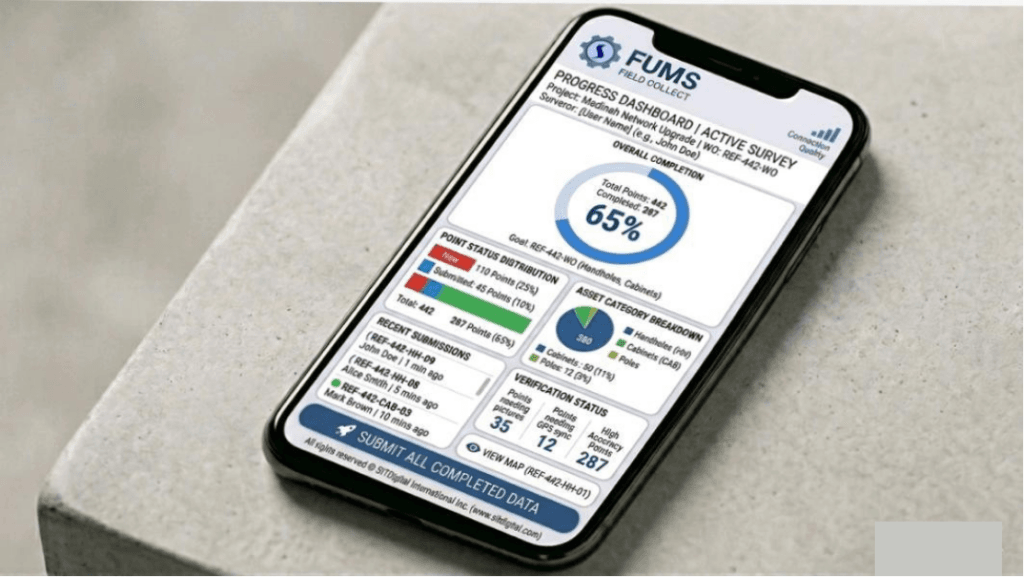
3. Seamless Field-to-Office Sync (The Collect App)
One of the most persistent revenue leaks in telecom operations is outdated “as-built” data. When field technicians execute fiber splicing or emergency repairs, those changes must instantly reflect in the central database. SIT Digital’s Collect App bridges this gap entirely, ensuring direct, automated synchronization between field field-crews and back-office asset management teams.
Why Modern Telecom Networks Need FUMS™
- Zero Data Mismatch: By removing the reliance on legacy CAD drawings or unindexed documents, FUMS™ establishes a definitive “Single Source of Truth,” ensuring engineering, field, and management teams operate on identical data.
- Accelerated Market Launch: Integrated route optimization and automated workflows significantly cut down the time required for HLD and LLD cycles, drastically reducing time-to-market for FTTH rollouts.
- Proactive Maintenance via Passive NOC: When a fiber cut or degradation occurs, FUMS™ integrates with OTDR testing to execute an Instant Fault Location trace. It maps the precise geographical coordinate of the failure within seconds, slashing the Mean Time to Repair (MTTR) from hours down to minutes.

Enterprise Architecture: Scale Without Limits
SIT Digital’s FUMS (GeoFM™) is architected from the ground up to support large-scale enterprise deployments:
- 100% Web-Based: Access the entire application securely via any standard web browser with customizable user roles and permission layers.
- Microsoft SQL Server Backend: Powered by a highly robust relational database management system to guarantee optimal query performance, transactional integrity, and data security.
- Global Compliance: Built explicitly to align with the stringent data models and telecom utility standards required by international markets, including the USA and the Kingdom of Saudi Arabia (KSA).
Conclusion
As network architectures grow more dense and complex, relying on siloed, outdated software components is no longer viable. Unified Fiber Management is an operational and strategic imperative. With SIT Digital’s FUMS™ and GeoFM™, your Physical Network Inventory (PNI) evolves from a static record book into an intelligent, highly responsive ecosystem engineered for the future of connectivity.